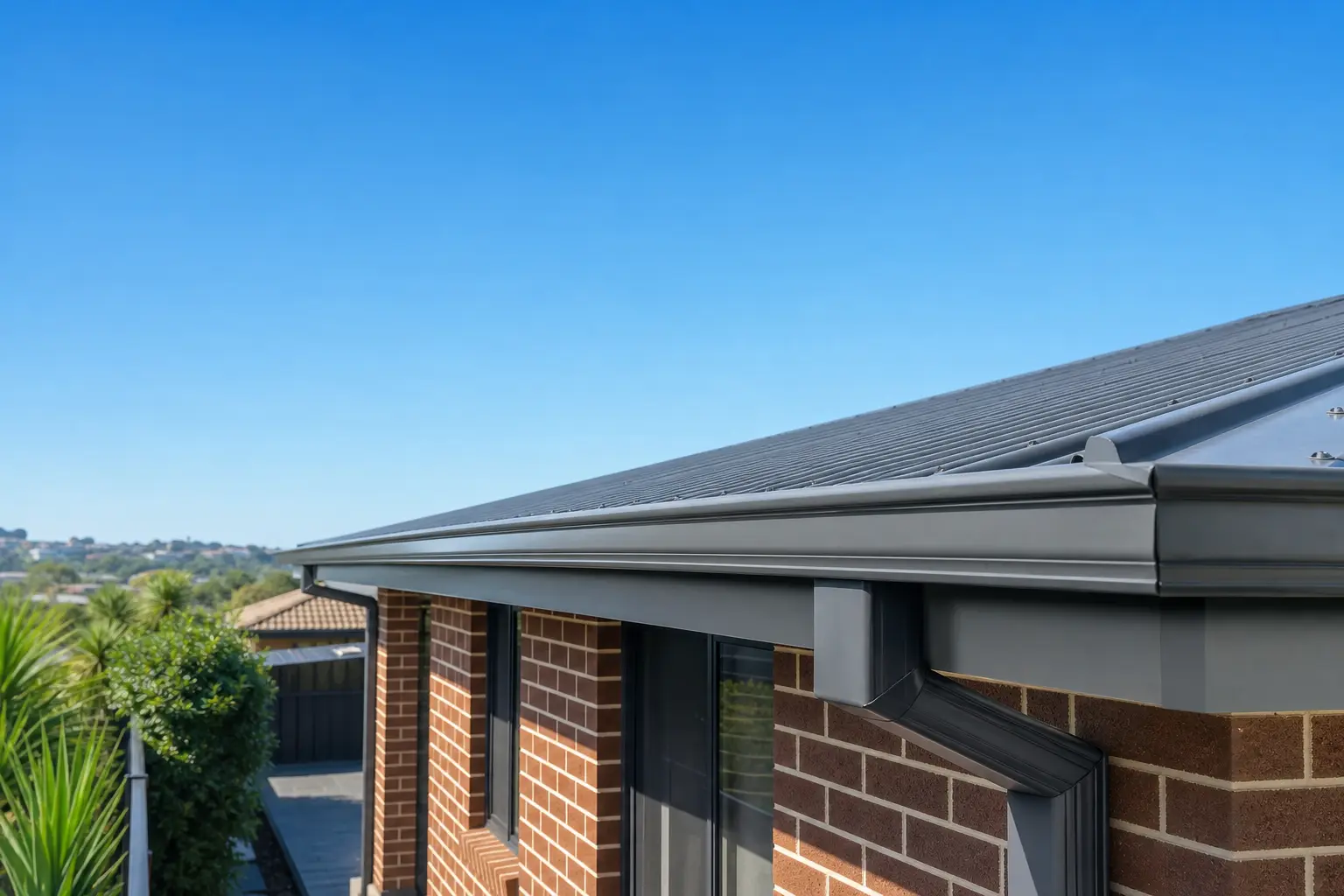
Roof Plumbing and Flashing Newcastle
Most roof leaks do not start in the middle of a sheet or a row of tiles. They start where the roof meets something else: a wall, a chimney, a skylight, a pipe, or another roof plane in a valley. Those junctions are sealed with flashings and valley irons, and when they rust, lift or were never installed well, water gets in. We install and replace flashings, fit valley guard and replace worn valleys on tile and metal roofs across Newcastle and the Hunter.
- 🛡️ 10-Year Workmanship Warranty
- 📍 Local Newcastle NSW Team
What's Included
- Leak tracing at roof junctions
- Flashing installation
- Flashing replacement
- Valley guard
- Valley replacement
Not sure if roof plumbing and flashing is what you need?
We inspect first and tell you straight: repair, restore or replace.
What roof plumbing covers
Roof plumbing is the metalwork that keeps water moving off a roof: flashings, valleys, ridge and barge details on metal roofs, box gutters, gutters and downpipes. It is less visible than tiles or sheets, but it is where a roof's weak points are. A roof can have perfectly sound tiles and still leak through a rusted valley or a wall flashing that has pulled away from the brickwork. This page covers flashings and valleys; gutters, downpipes and fascia covers have their own page.
- Apron and step flashings where a roof meets a wall
- Chimney flashings on older homes with brick chimneys
- Pipe and vent flashings around penetrations through the roof
- Valley irons where two roof planes meet
- Ridge, barge and transition flashings on metal roofs
- Box gutters on some older homes and light commercial buildings
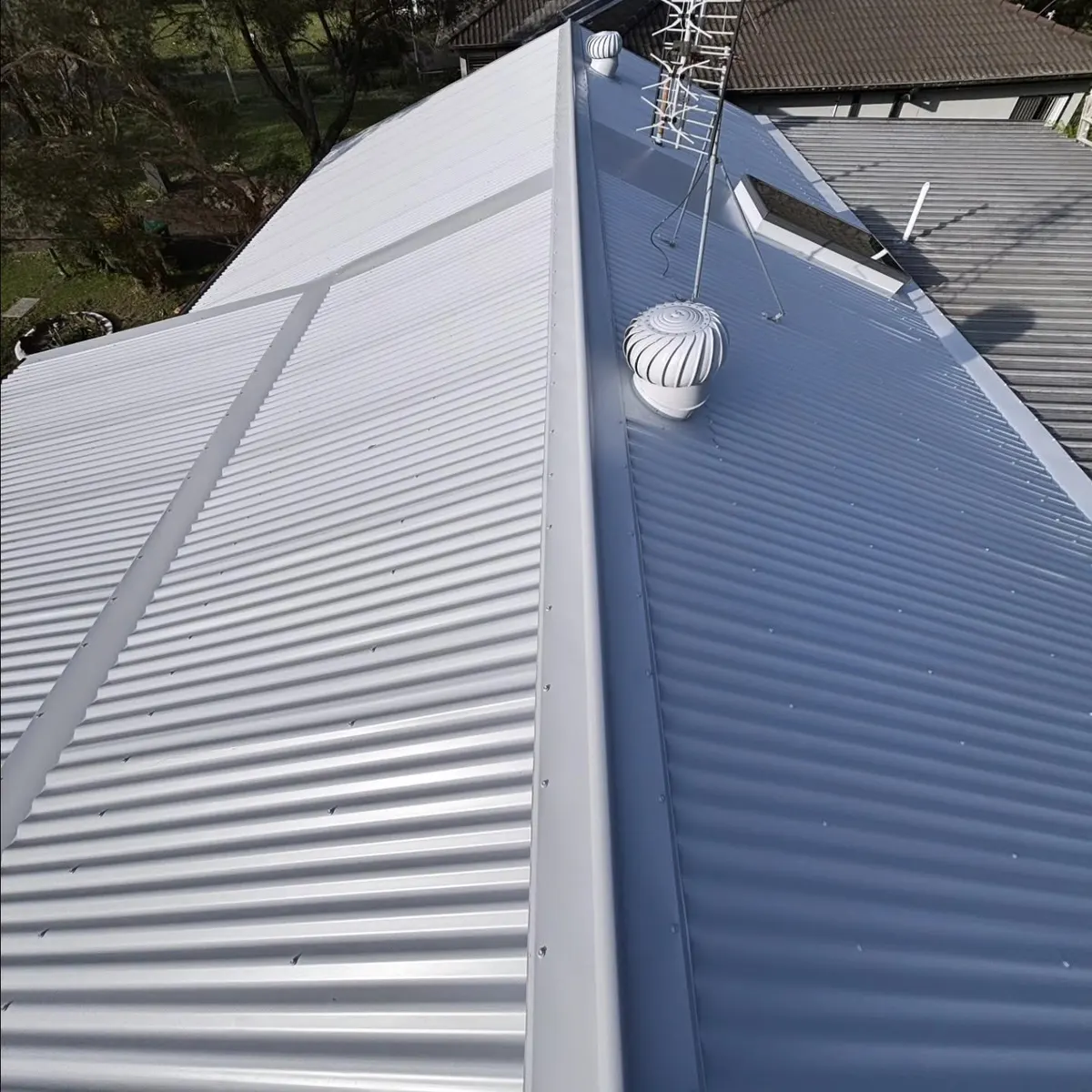
Flashing installation
New flashings are needed whenever the roof changes: an extension ties into the existing roof, a skylight or roof vent goes in, a wall is raised, or a new pipe comes through the roof. Good flashing work is mostly about overlap and direction. Water must always be led over the top of the next piece, never behind it, and the flashing has to allow for the roof and wall moving at different rates. On metal roofs, flashings are folded to suit the sheet profile. On tile roofs, flashings are dressed down over the tiles so they follow the shape and still shed water.
- Flashings for extensions and additions where new roof meets old
- Wall abutment flashings, cut into brickwork or fixed with a counter flashing
- Penetration flashings for pipes, vents and flues
- Flashings to suit skylight installation in tile and metal roofs
Flashing replacement
Flashings wear out. Older galvanised flashings rust, sealant dries and cracks, and flashings fixed only with silicone eventually pull away. Near the coast, salt deposits can speed up corrosion on some properties, especially on metalwork that rain does not wash clean. Replacement means removing the old flashing, checking what is underneath for water damage, and installing a new one that is properly fixed and lapped rather than relying on a bead of sealant. We also pay attention to materials, because some metals react with each other and cause corrosion; the new flashing is chosen to suit the roof it sits on.
- Rust along the flashing or at its fixings
- Flashing lifted away from the wall or roof, often after strong wind
- Cracked or missing sealant being used as the only seal
- Staining on ceilings or internal walls below a junction
- Mortar pointing at a chimney or wall abutment breaking down
Valley guard
A valley is a channel, and channels collect debris. Leaves settle in the valley, hold water and form a dam, and in heavy rain water can back up and spill over the sides of the valley iron under the tiles or sheets. Valley guard is a mesh fitted along the valley to keep most leaves out while letting water run. It suits homes near trees and is often installed alongside gutter guard. Like gutter guard, it reduces cleaning rather than ending it.
Valley replacement
Valley irons rust from the inside out as wet debris sits in them, and on older roofs they are often the first metal to fail. On a tile roof, replacing a valley means lifting the tiles along both sides, removing the old iron, fitting a new valley, then relaying the tiles and bedding and pointing where the roof design calls for it. On a metal roof, the sheets along the valley are unfixed, the valley is replaced and the sheets are refixed. Valleys are also a common source of leaks after hail or heavy storms, when debris blocks them faster than they can drain.
| Valley guard | Valley replacement | |
|---|---|---|
| What it solves | Leaves building up and blocking the valley | A valley iron that is rusted, holed or incorrectly installed |
| When it suits | Sound valleys on homes near trees | Valleys with rust through, leaks or distortion |
| Tile roof work | Mesh fixed along the valley edges | Tiles lifted, new valley fitted, tiles relaid and bedded where required |
| Metal roof work | Mesh fixed over the valley | Sheets unfixed, new valley fitted, sheets refixed |
| Ongoing care | Occasional clear of debris on the mesh | Keep the new valley clear; consider valley guard |
How the work is done
How flashing and valley work runs
- 01
Free on-site inspection
We check flashings, valleys and penetrations, and trace any leak back to its source.
- 02
Written quote
The quote names each flashing or valley to be installed or replaced and the material used.
- 03
Remove and assess
Old flashings or valleys come off and we check the timber and sarking below for damage.
- 04
Install
New metalwork is fitted, lapped and fixed so water runs over each piece, not behind it.
- 05
Reinstate and test
Tiles or sheets are refitted, and where practical we run water over the area to confirm it is sealed.
What the job covers
Everything included in your roof plumbing and flashing
One written quote
Every item is set out in the quote you receive after inspection.
- 01
Leak tracing at roof junctions
We find where water is actually getting in, which is often metres away from the stain on the ceiling.
- 02
Flashing installation
New flashings for extensions, wall abutments, pipe penetrations, chimneys and skylights.
- 03
Flashing replacement
Rusted, lifted, cracked or poorly installed flashings removed and replaced with a compatible material.
- 04
Valley guard
Mesh fitted along roof valleys to stop leaves building up and forcing water over the valley edges.
- 05
Valley replacement
Worn valley irons replaced, with tiles lifted and rebedded or sheets refixed along the new valley.
Let's take a look
Free on-site inspection and a written quote for the work you actually need.
Straight about price
What does it cost?
We have no sourced guide price for flashing and valley work, so we will not publish one. The price depends on how many flashings or valleys are involved and their length, whether the roof is tile or metal (lifting and relaying tiles along a valley takes longer than refixing sheets), roof pitch and access, the flashing material, and whether timber or sarking underneath needs repair once the old metal is removed. Your exact price is confirmed in writing after a free on-site inspection.
Questions before you enquire
Roof Plumbing and Flashing questions
Straight answers to what homeowners ask us most about roof plumbing and flashing.
How do I know if a leak is coming from a flashing?
Leaks near walls, chimneys, skylights or pipes, or at the low end of a valley, often point to flashings or valleys. Water can travel along timber before it drips, so we trace the leak on the roof rather than guessing from the ceiling stain.
Can a flashing just be resealed with silicone?
Sometimes as a stopgap, but a flashing that relies only on sealant will usually fail again. A proper repair means the flashing is correctly lapped and fixed so it sheds water even without sealant.
What is valley guard?
A mesh fitted along the valleys of your roof to keep leaves from building up and blocking water flow. It suits homes near trees and is often fitted with gutter guard.
How long do valley irons last?
It varies with the material, how clean they are kept and the exposure of the site. Valleys that regularly hold wet leaves rust much sooner. We check the condition on site rather than going by age alone.
Do you do flashings for skylights and extensions?
Yes. Any new opening or roof junction needs flashing. We flash skylights we install and can flash an extension where it ties into the existing roof.
Does salt air affect flashings near the coast?
It can, on some properties. Salt that settles on metalwork and is not washed off by rain can speed up corrosion. That is why we check sheltered spots and fixings closely on homes near the beaches.
Is roof plumbing work licensed in NSW?
Licensing requirements in NSW depend on the type and value of the work. Ask any contractor for licence details that cover your job and check them with NSW Fair Trading before work begins.
Roof Plumbing and Flashing across Newcastle NSW
Servicing all Newcastle NSW suburbs including:
Related services
- Roof Repairs →Leak tracing and targeted repairs to tile and metal roofs, including storm damage and insurance reports.
- Gutters and Downpipes →Gutter repairs, replacement, cleaning and guards, plus fascia covers and downpipes that actually drain.
- Skylights →Skylight installation in tile and metal roofs, and repairs to skylights that leak or have failed.
- Roof Inspections →Condition assessments and written roof reports for storm claims, purchases, strata and commercial sites.
Request an inspection
Ready for honest advice?
Free on-site inspection, written quote, and a straight answer: repair, restore or replace. Call (02) 4047 0860 or use the form.
GET YOUR FREE
QUOTE
Written quote after inspection. Free of charge.
- ✅ Local Team
- ✅ Written quote
🕖 Mon to Sat: 7:30am to 5:30pm
Prefer to talk? Call (02) 4047 0860